Love Is Not a Metric Space
The geometry behind a 97 percent match that goes nowhere.

Eric Garcia, PhD
September 11, 2026 · 12 min read

Here is the promise, stated as fairly as I can, because everything below depends on taking it seriously. Describe yourself in enough detail. Get enough other people to do the same. Build a good enough matching function. Then the right person for you is a query away.
That is not a stupid idea. It is a very good idea, built by very good engineers, and for most of what it touches it works. It finds you a song, a restaurant, a used car with the mileage you asked for. So take all of it as given: the data, the scale, the algorithms, the good intentions. And then watch the idea fail anyway, on its own terms, on one person.
If you would rather watch this argument than read it, there is a talk of the same name: Love Is Not a Metric Space.
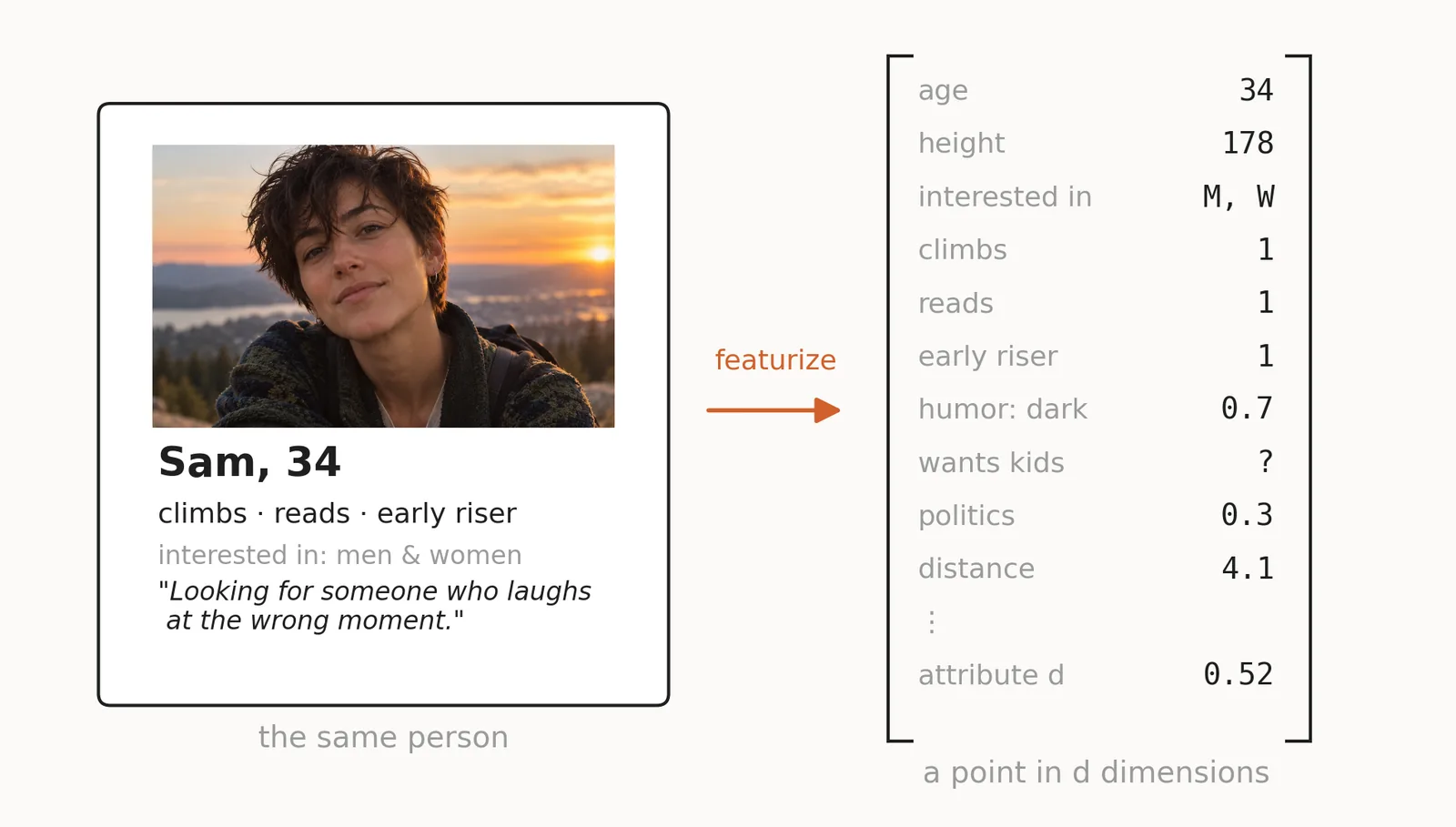
This is Sam.1 Thirty-four. Climbs, reads, gets up early. Interested in men and women. One line on the card, written at eleven at night, about wanting someone who laughs at the wrong moment. Sam filled out the long questionnaire honestly, which is more than most people manage.
On the left is Sam as you would see them. On the right is Sam as the app sees them: the same person as a column of numbers, one per attribute. That column is called a feature vector.
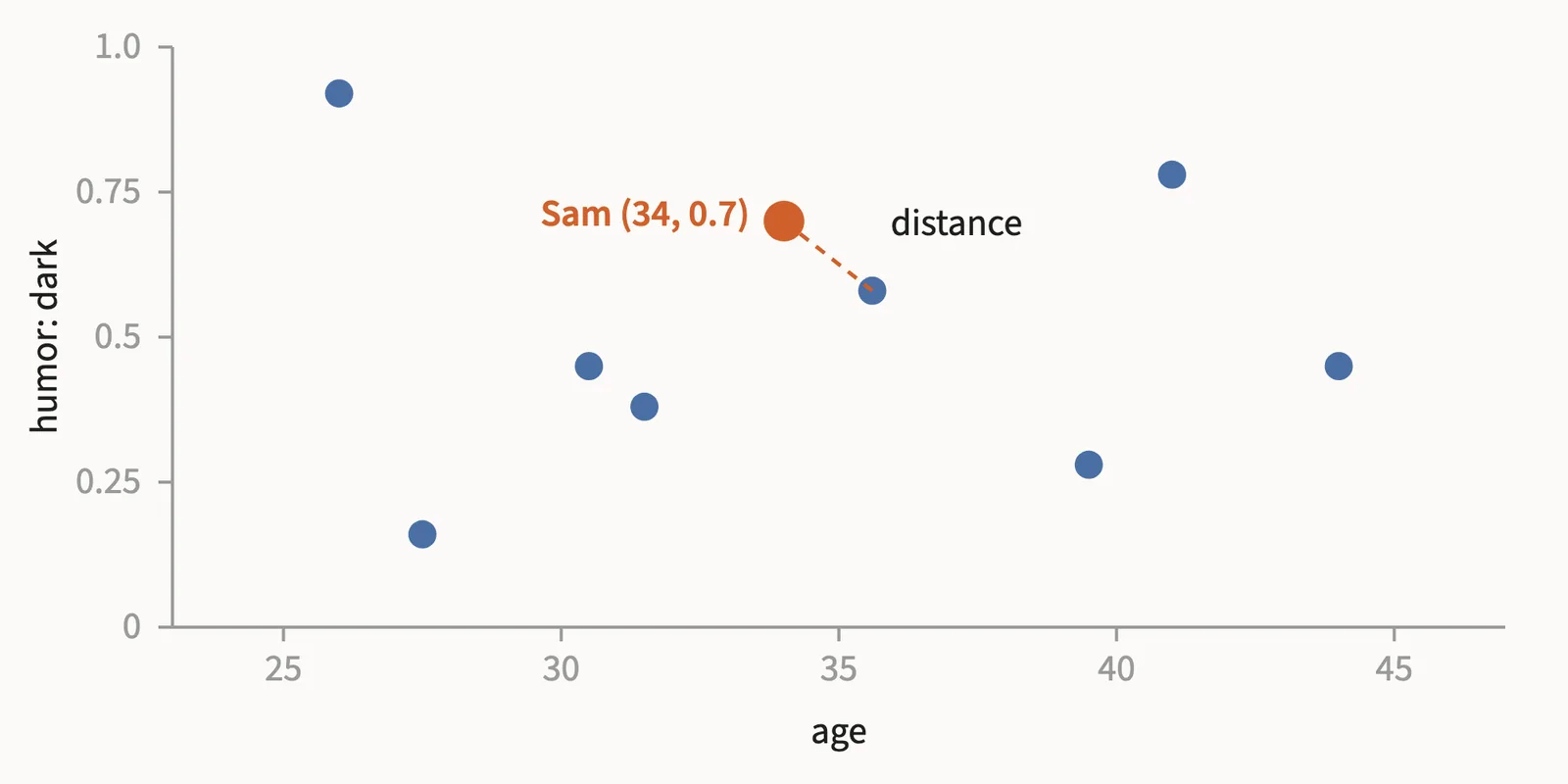
Take two of Sam's numbers: age, and the score the app gave them for dark humor. Age along the bottom, humor up the side, and Sam becomes a point, and so does everyone else on the app. And the moment people are points, you can measure between them. That dashed line is an ordinary ruler laid on the plane. Who is most like Sam has just become which point is closest, and closeness is a number.
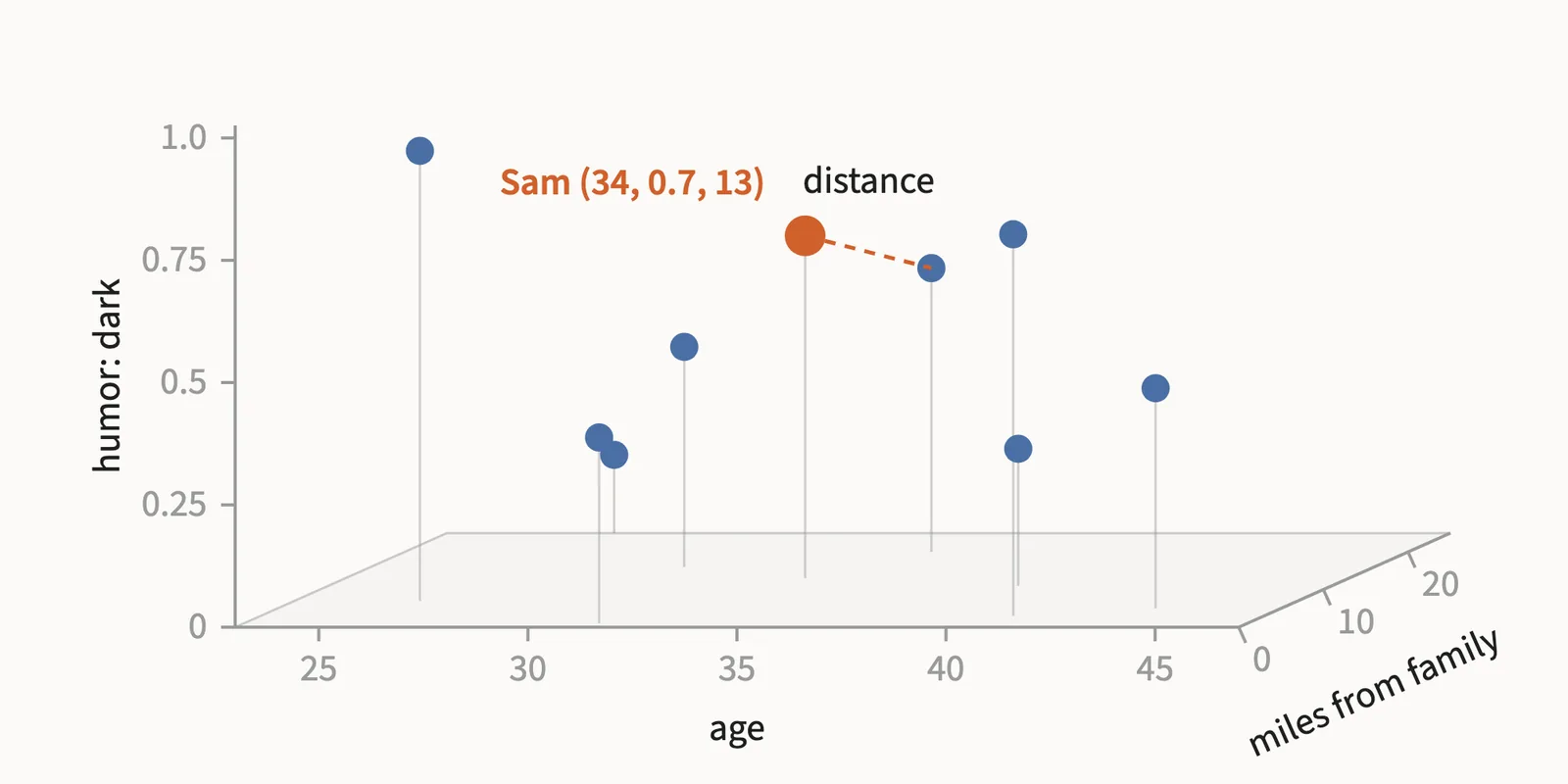
Add a third number, how far they live from their family, and the plane becomes a space. Same people, same Sam, and the ruler still works. Now add a fourth axis. You cannot draw it and neither can I, but the arithmetic does not care; it just has one more term. Add the rest of the questionnaire, one axis per question. That is a feature space: one axis per attribute, one point per person, and a ruler that works in any number of dimensions. Matching becomes geometry. Find the points nearest Sam's and show them to Sam in order.
What's wrong with that is not what people usually say is wrong with it. It isn't that compatibility can't be measured. Recommender systems measure the fit between two things every day, and you have a playlist that proves it. The claim is narrower, and it is this: compatibility is not a distance. A distance weighs every feature the same way for everyone. Compatibility does not. The weight on every feature changes depending on who is at the other end. And a quantity whose weights change with the pair does not add up across people the way a distance does. You cannot get from Sam fits B and B is like C to Sam fits C. Compatibility does not triangulate.
One ruler for everyone
Sam's first match came with a number beside it. Ninety-seven percent. A woman a few years younger, who had also filled the whole thing out honestly. They met for a drink. She was pleasant. Sam was pleasant. They agreed about everything the questionnaire had predicted they would agree about, and by the second drink they had run out of it. Nobody did anything wrong. She was a stranger at the table, and she stayed one.
So what was the ninety-seven? One ruler, applied to everyone. The app weighted its questions once, the same way for every pair in the city, and the weights that ended up dominating were the ones attached to the biggest numbers: miles from Sam's apartment, a politics question with a wide scale. Those were never Sam's weights with her. They were nobody's weights with anybody. They were the questionnaire's.
You have felt this, if you have used one of these. The top match who turns out to be, as far as you can tell, a person selected at random. That is not a bug you happened to hit. That is one ruler for everyone, doing exactly what it was built to do, on a question it was never built for.
Learn the metric
You have an objection ready, so I'll make it for you. Fine — nobody serious uses a ruler off the shelf. You learn the metric. Take every pair that matched and every pair that didn't, and train a model to weight the questions so that the ones that mattered count and the ones that didn't fall away. Embeddings, metric learning, matrix factorization. This is a solved kind of problem, and every graduate student meets it in the first year.
That objection is right, and it deserves granting properly, because it is the strongest thing on the other side. Recommender systems find compatibility every day — not a property of you, a fit between you and a thing. They do it with one move. If you liked B, and B resembles C, you will probably like C. That step is the whole engine, and it works because taste transfers. Your taste in films is roughly one thing, carried from film to film, so a near neighbor of something you loved is a good bet.
Granted, completely, for films. The question is whether the step transfers to people, and the way to find out is to look at a case where it doesn't.
The second date
The app ranked him low. He had answered three heavily weighted questions the wrong way: he doesn't get up early, he doesn't climb, and he wants to live near his family. Sam went because the restaurant was near the gym.
He was four minutes late and said so without apologizing twice. He noticed the waiter was having a bad night and made it easier rather than harder. There was a silence about a minute in that should have been awkward and wasn't. And he laughed at the wrong moment, which is the one thing Sam had actually asked for, and the one thing the questionnaire had no way to ask about. By the time the menus came, Sam knew.
None of that is a story about chemistry. Wanting to live near your family had been, for Sam, a dealbreaker with someone else. With him it was the point. Same answer, opposite weight. That weight did not belong to Sam and it did not belong to him. It belonged to the pair.
Which is why there is no single metric to learn. Learning the metric means learning one set of weights: which questions matter, for everyone, once — or at best one set per person, if you're careful about it. But the weight on lives near family was not Sam's and was not his. There is no single ruler, because the ruler is different on every line between two people.
Compatibility doesn't triangulate
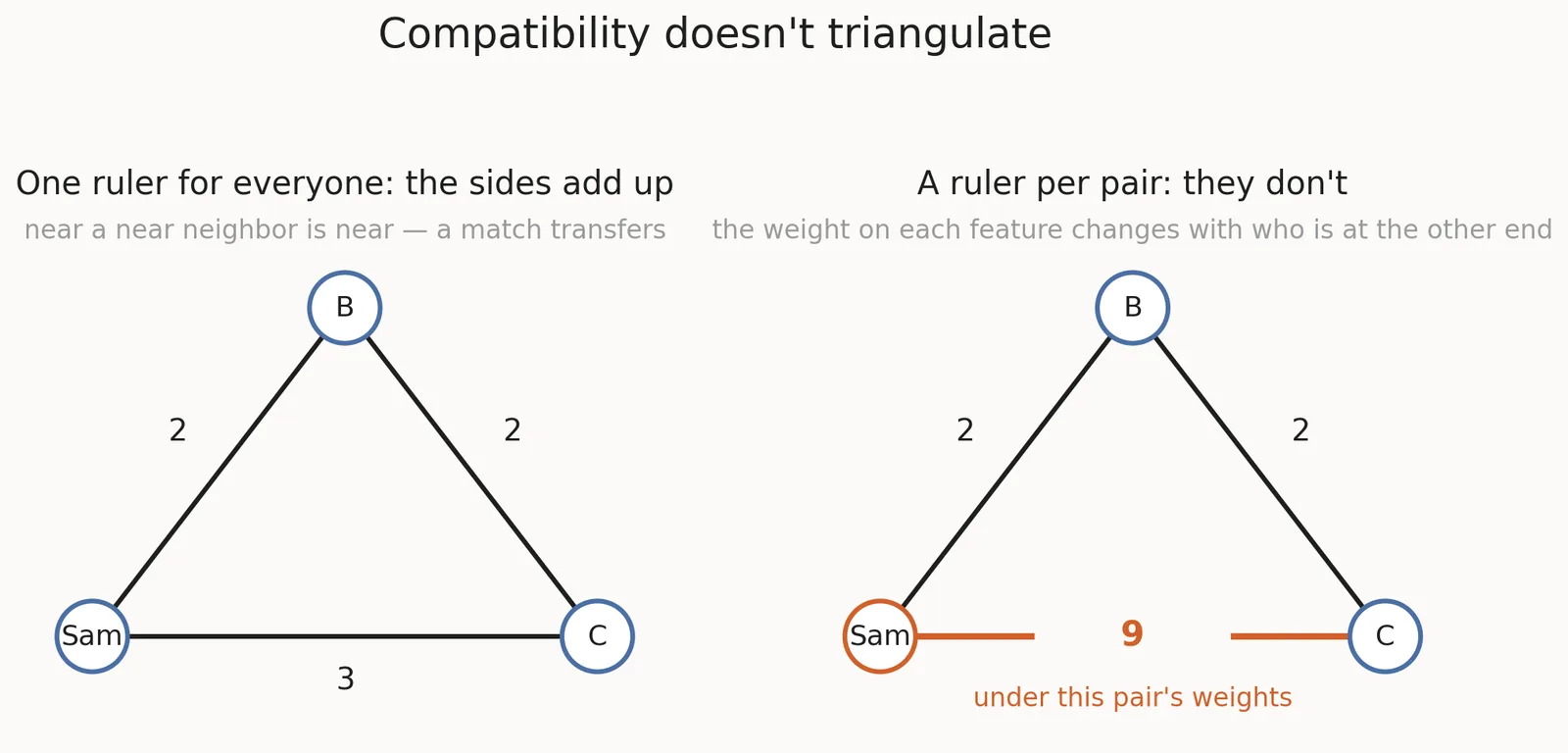
This is the picture the argument rests on.2 Three people: Sam, B, and C.
On the left, one ruler for everyone. Sam is two from B, B is two from C, so Sam cannot be more than four from C, and here they are three. The sides add up. That is what makes something a distance — a near neighbor of a near neighbor is near — and it is exactly the step the recommender takes when it reasons from what you liked to what you will like. On the left, that step is legal.
On the right, the same three people, each pair measured with its own weights, because that is what the second date showed us. Sam to B, two. B to C, two. Sam to C, under that pair's weights, nine. The sides do not add up. No triangle closes. Sam fits B, and B is like C tells you nothing at all about Sam and C, because the ruler that measured Sam and C is not the ruler that measured the other two sides.
The engineers are already thinking: fine, then learn a weight per pair. Two things stop you, and they are both about arithmetic rather than about romance.
The first is that the pair space is enormous and the evidence in it is almost nothing. A city's worth of people is a city's worth of people squared in pairs, and the data you have on any particular pair is at most one date, usually none at all. You can learn one ruler from a million matches. You cannot learn a million rulers from one date each.
The second is that the data you do have is the wrong data. The model trains on what people tapped — a two-second decision made with a thumb. Sam's second date never got logged; the app has no field for the silence was fine. So even the single ruler it learns is a ruler for glances rather than for tables. The incentive from inside the company runs the same way: a match that works, two people who meet and delete the app, is a lost user. Twice.
Where the weights come from
If the weights belong to the pair, the obvious next question is where they come from, and the honest answer is that they come from the encounter itself.
Iain McGilchrist describes two modes of attention that we need both of, and that frame is the whole of what I am borrowing from him.3 One isolates a thing from its context, takes it apart, and re-presents it — presents it again — as a model. The other attends to the whole, to the living thing, to what is between people. The first is the emissary: powerful, genuinely useful, and meant to serve. The second is the master. The trouble starts when the emissary decides it is in charge.
A profile is a re-presentation. Turning Sam into that column of numbers is the emissary's characteristic move, and it is a good move; the same move built medicine and bridges. The usurpation is not that we abstract. It is that we mistake the map for the territory and then optimize against the map. We ask the column what only the table could tell us, and when the column answers — because a model always answers — we believe it, because it arrived with a number attached. Ninety-seven.
Go back to the second date and try to put it on the form. Timing. How he treated the waiter. Whether the silence was fine. The laugh at the wrong moment. Now write the questions. Treats waiters well: yes. Silence: comfortable. You can hear that it is absurd. These are not missing features waiting for a longer questionnaire. They are properties of the whole encounter. They exist at the level of two people at a table and nowhere else. He does not keep good timing in a drawer at home. It happened, in front of Sam, or it didn't.
That is where the weights come from, and it is why no schema can hold them: the things that set them were never in the schema, and some of them did not exist until the two of them sat down. Sam's own account of the questionnaire is that the honest answer to about a third of it was it depends on who's asking, and there was no box for that. There couldn't be. It depends on who's asking is a weight that changes with the pair, which is the whole argument in five words.
One axis
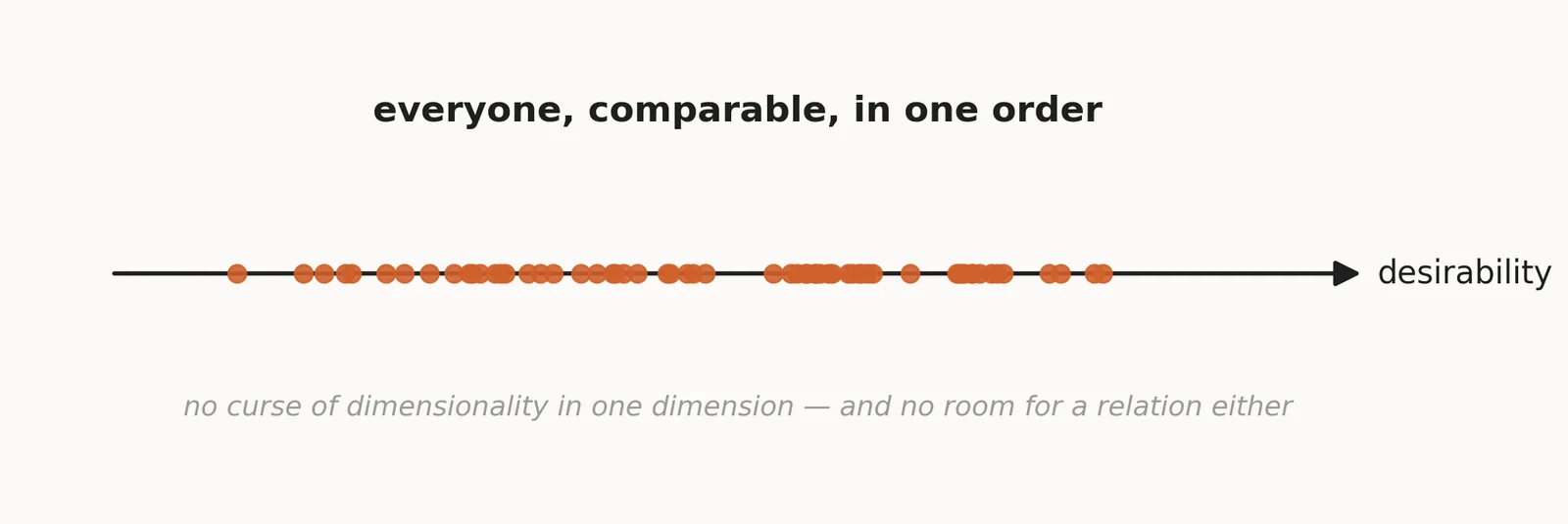
You already know what happened next, because you watched it happen. The apps mostly abandoned the questionnaire. What replaced it was the swipe: a photo, a name, an age, and one decision, yes or no, in about a second, with a thumb, on a couch. Whatever that interface measures, it's close to a single number about a single person. Call it desirability.
Notice what's gone. There are no pairs on that line. Desirability ranks individuals; compatibility relates two of them; and a line has room for a rank and nothing else. The triangle problem is solved, in the sense that there's no longer a triangle. The mathematics became tractable by removing the thing being measured.
I don't think that was cynicism. It is what happens when the only quantity you can collect cheaply is the one that fits in a thumb, and the thing you actually wanted was never in the database to begin with.
The room
So what do you do on Saturday, given all of that?
Not a better app. If someone builds one I'll be glad, and it won't fix this, because the fix is not a measurement problem. If compatibility exists only in the encounter, then the only instrument that detects it is the encounter, and the question becomes how to get into more of them with people worth encountering.
Go where the filtering happens on what people do rather than on what they say about themselves. A climbing gym at six in the morning. A reading group for a book nobody has heard of. A friend of a friend's apartment with too many people in it, thrown for a strange reason. A room full of people who came for the same strange reason is already a better-conditioned sample than anything a query returns, and it filters on the one thing no profile field captures, which is what someone actually does with their time. You don't have to describe yourself as the sort of person who would be there. You are there.
That is not a retreat from the argument into folk wisdom. It is the argument. The thing you want lives on the line between two people, so put yourself in rooms where the lines can form.
Sam went to one of those, eventually, and almost didn't. I'm not going to tell you who Sam met, because nothing about that person was in a column anywhere, ranked next to Sam, waiting to be found. They were in the room for the same strange reason, and the rest of it happened on the line between them, the way it always does.
If you met your partner on an app, you may be wondering whether I've just called your marriage a rounding error. I haven't. Look at what actually happened: the app put two people in a room, and then the room did the work — the timing, the waiter, the silence — and it would have done the same work at a bus stop. The app was the bus stop. That's a fine thing to be, and it's what the swipe is honestly good at: getting a lot of strangers into a lot of rooms. What it cannot do is the part you remember.
The apps set out to solve search, and I'll give them this, because I said I'd grant them everything and I meant it: they solved it. You can find more people faster than anyone in history. The search was never the hard part.
Love was never a search problem.
Footnotes
-
Sam is invented — a composite rather than someone I know, and the three dates are illustrative rather than reported. The portrait on the card and the picture at the top are generated as well; there is no one behind either. Nothing here is a real person's evening. Every detail is the kind of thing that happens to people who use these apps, which is the only work the example has to do. ↩
-
The numbers on the triangle are illustrative, chosen to be small enough to check in your head. The points in the two scatter plots are illustrative as well; none of them is a real user. ↩
-
Iain McGilchrist, The Master and His Emissary: The Divided Brain and the Making of the Western World (Yale University Press, 2009). The two-modes frame is the book's central argument; I am borrowing it and making no claim of my own about hemispheres. ↩

Eric Garcia, PhD
Founder & Principal Consultant
PhD in Machine Learning from UW. Former Spotify ML engineer. 15+ years building production ML systems.
Learn more about Eric →Need Help with Production ML?
We help companies build ML systems that actually work.
Learn About Our ML Consulting