The Coordinates You Happen to Have
Why four interviewers know less about a candidate than any one of them did.

Eric Garcia, PhD
September 14, 2026 · 12 min read
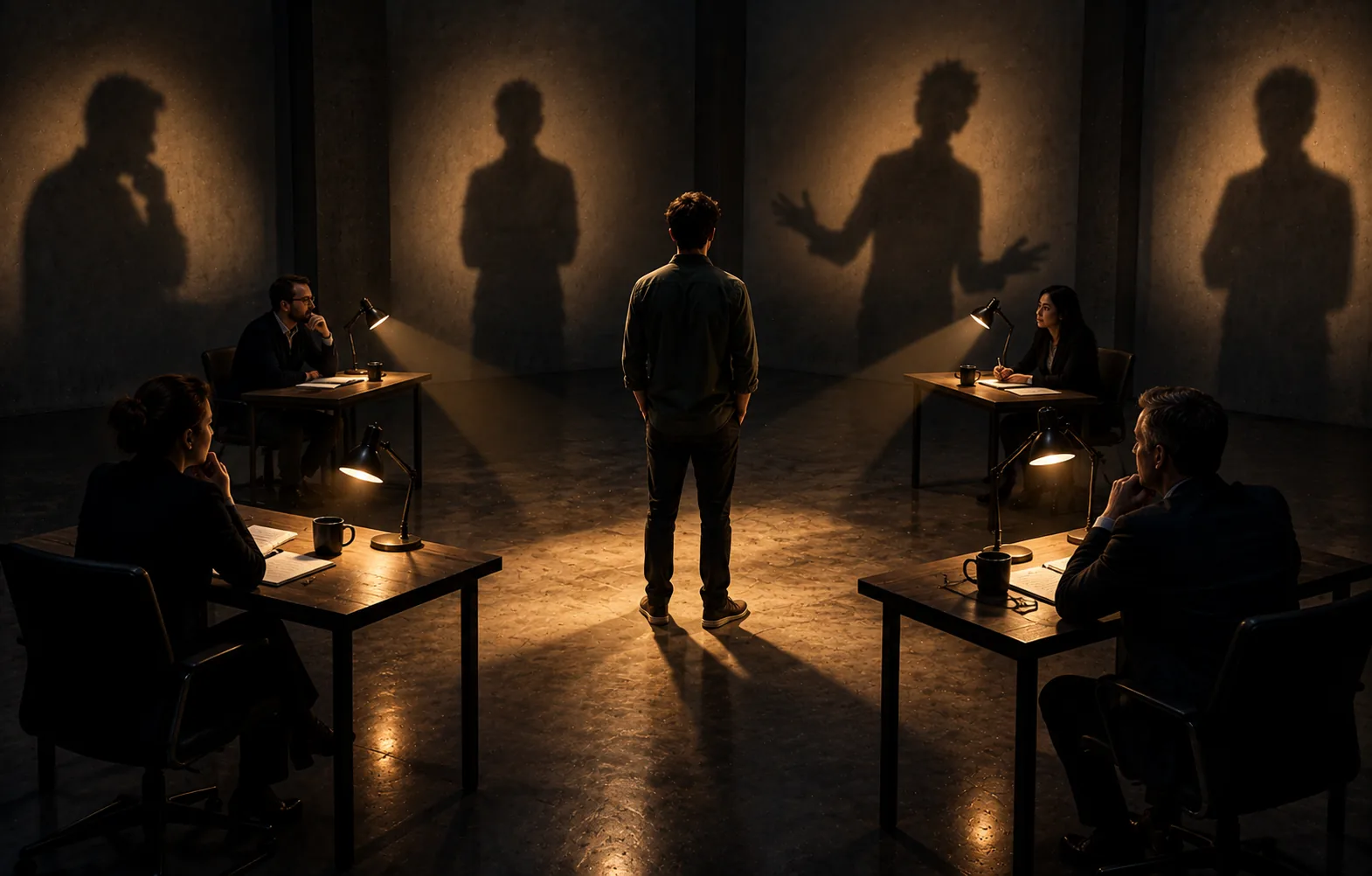
Four people interviewed Ari on a Thursday.1 On Friday they sat in a room to decide.
The engineer who ran the systems design said Ari was careful — slow to commit to an approach, fast to name what would break it, the kind of person who finds the failure mode before the whiteboard is full. The manager said Ari was warm and a little deferential, and wondered out loud whether they'd push back on a bad decision from someone senior. The person who ran the values conversation said Ari was the most curious candidate they'd met all quarter, and told a story about a question Ari asked that wasn't on anyone's list. The founder, who had twenty minutes at the end of a long day, said Ari seemed fine.
Then the room did what rooms do. It went looking for the overlap.
Nothing in those four accounts contradicts anything in the other three. That is the part worth sitting with before the room moves on. The debrief treated four descriptions as four noisy measurements of one quantity and reached for the signal they had in common. They weren't four noisy measurements of one thing. They were four clean measurements of four different things.
If you would rather watch this argument than read it, there is a talk of the same name: The Coordinates You Happen to Have.
What a shadow throws away
Stand a soup can on a table under a lamp and you get a circle. Move the lamp to the side and put a wall behind it and you get a rectangle. Both shadows are correct. Neither is a distortion of the other, and no amount of studying the circle will ever give you back the rectangle.
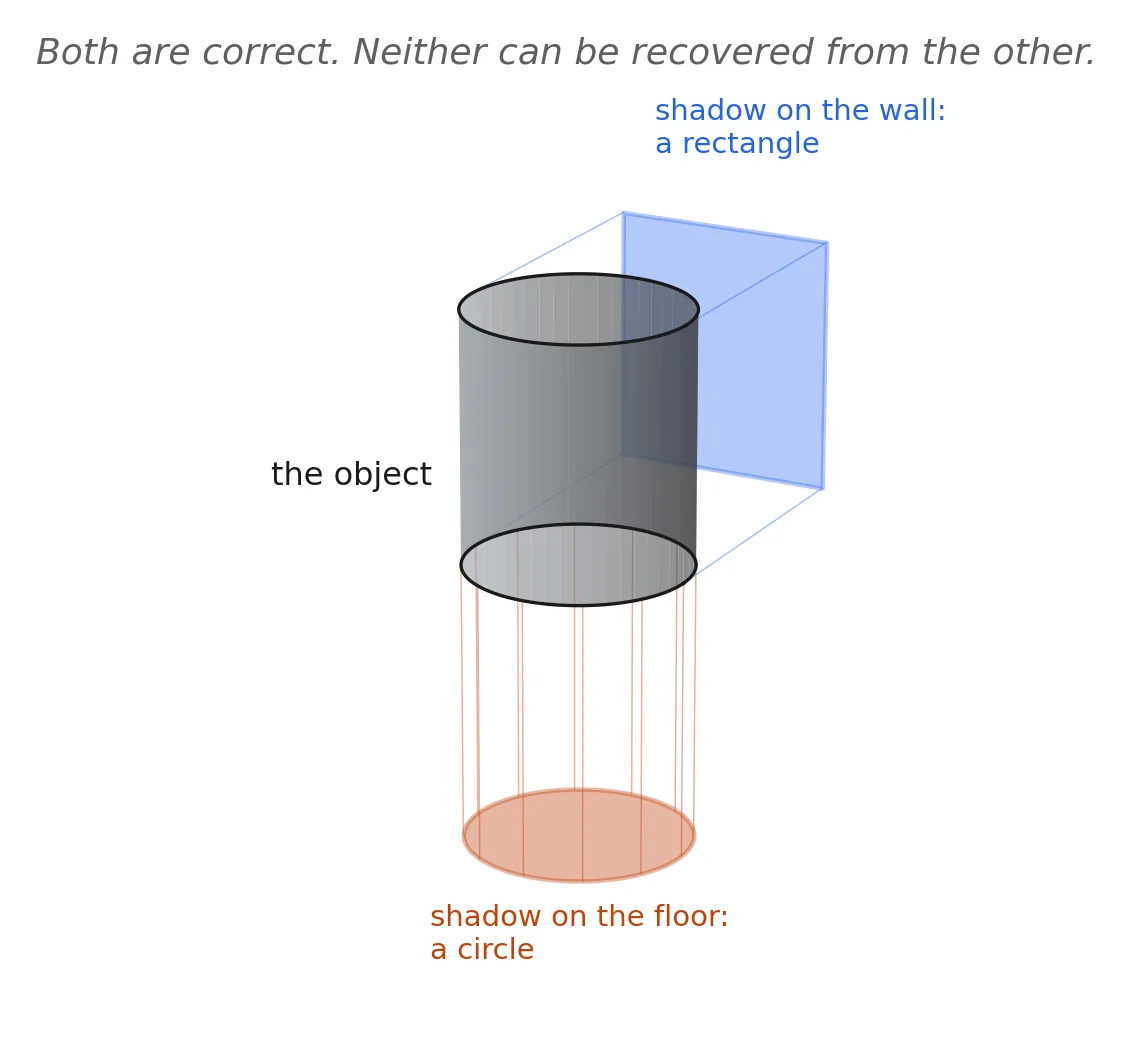
The word for what the lamp is doing is projection, and it's worth being exact about the kind of damage it does, because the ordinary intuition is wrong. A projection is not a blurry photograph. It doesn't approximate the height of the can, or record it imprecisely, or leave a smudge where the height used to be. Looking down from above, height is simply not one of the things the picture is made of. The circle is a complete and exact description of the can along every direction the circle has. It's missing a direction, and a missing direction leaves nothing behind — no gap, no error bar, no ragged edge where more information would have gone.
That's why you can't work backwards. Given the circle, the can is one of infinitely many objects that cast it, and they're not near-misses of each other. A cylinder, a cone, a sphere, a stack of coins, and a wobbling spiral all put down the same disc. The circle doesn't narrow them down. It rules out everything that isn't round from above and then stops.
A matching algorithm runs this same projection on a questionnaire and calls what comes out compatibility, which is the argument of Love Is Not a Metric Space. The machine at least publishes its axes. You have never seen yours.
More directions than anyone has coordinates
You have the objection ready, and it is a good one.
People are describable, and a whole field has spent decades describing them. Trait psychology names dimensions along which people differ, measures them with a questionnaire, and predicts from the measurements. Anyone who tells you personality is unmeasurable has confused hard with impossible, and is usually protecting something. So take all of it as given.
Then notice what a trait is. A trait is a direction along which enough people varied that somebody found it worth naming. That's not a criticism; it's the definition, and it's also the selection criterion. The whole enterprise works by finding the axes that recur across populations, because an axis that shows up in three people can't be validated and an axis that shows up in one isn't a trait at all — it's a person.
And that's the problem, because you are not hiring a population. A dimension earns its place in the model by being shared. The things that decide what Ari actually does on a Tuesday in March, when the project is failing and the person who'd normally catch it is on leave, are the directions that were too rare to survive that filter. They didn't recur often enough to get a name, so there's no question that asks about them and no column that holds them.
A trait is what's left of a person after you've removed everything that didn't generalize. That's a useful object. It is not the person, and the residue is not noise.
Your axes came from people you already met
So where do your coordinates come from? Not from the model. Almost nobody reads a stranger by running an inventory; you read them by the only apparatus you have, which is everyone you've met up to now.
Every direction you can see a person along was installed by somebody earlier. You've known someone who got quiet under pressure, so goes quiet under pressure is an axis you have, and you can place a new person on it within about a week. You've known someone whose competence and confidence came apart — who was good and didn't know it, or the reverse — so you have that axis too, and you'll catch it in a stranger in one meeting.
If you haven't, you won't. And the missing quality doesn't arrive as a blank, or as a question, or as something you notice you can't read. It lands on some axis you do have and gets recorded as something else entirely. The person who's good and doesn't know it reads as unambitious, if unambitious is an axis you carry and quiet about being good isn't. Nothing in the experience feels like a gap. You just met someone unambitious.
Go back to the manager who thought Ari was deferential. The manager has that axis because of somebody four years ago — a report who was pleasant in every meeting, agreed in the room, and let two bad decisions go through without saying a word, and it cost the manager a quarter. That report installed the axis. Ari, who has been in the building for forty-five minutes and is being polite the way you're polite in a building you've been in for forty-five minutes, gets a reading on it.
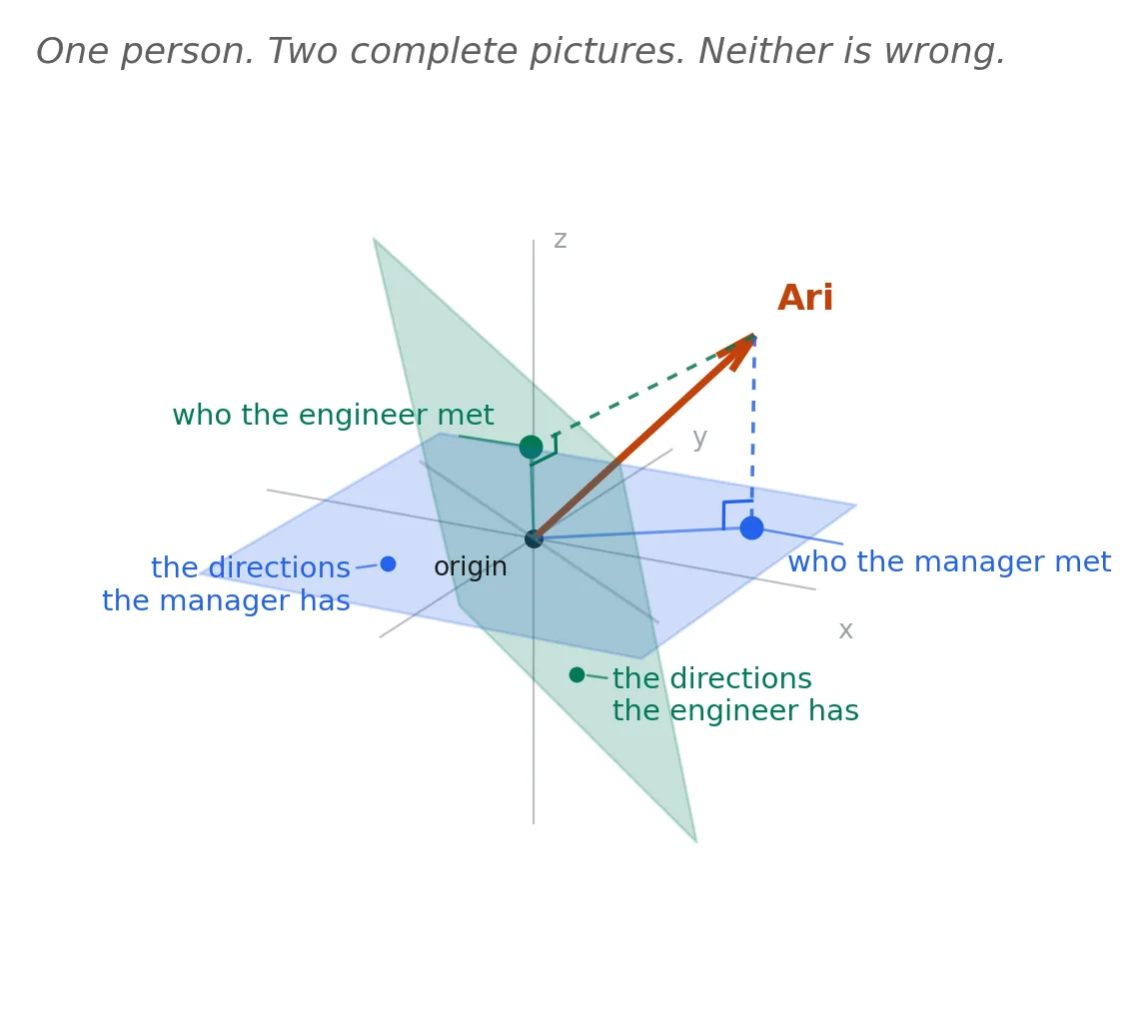
Two planes, two dots, one arrow: the same person read twice, and neither dot is the worse reading. The projection is not conservative. Having dropped the directions it has no coordinates for, the machinery does not hand back a partial picture with holes in it and a note about what it couldn't see. It extrapolates, freely and confidently, inside the space it kept — filling in what a person like that would probably do in a meeting it never saw, extending them past anything it observed, checking the result for consistency and finding it consistent, because a picture built out of a few axes is going to be consistent along those few axes.
So the manager doesn't leave the room thinking I have no information about whether Ari pushes back. The manager leaves the room worried that Ari won't. That's not a gap. That's a whole person: coherent, specific, predictive, arrived at honestly, and assembled out of coordinates that came from a different human being in a different building four years ago.
The projection is never blank. That's exactly why it's never suspected.
The room chooses which directions get excited
There's a second thing going on, and it isn't about the observer at all.
A setting doesn't display a person. It excites part of them and leaves the rest at rest. A systems design interview reaches for how somebody thinks when they don't know the answer yet; it has no way to reach for how they behave when a colleague is struggling, because nothing in the hour puts a struggling colleague in front of them. That isn't the interviewer failing to look. There's nothing there to look at. The dimension wasn't dormant and unobserved — in that room, for that hour, it was not in play.
This is why the two people in your life who know you best can describe you in ways that don't overlap, without either of them being fooled. Your closest colleague has watched you under a kind of pressure your oldest friend has never once seen you in, and the reverse is just as true. They're not two angles on one view. They're measurements in different subspaces, and each of them is complete.
It's also the practical half of the argument, and the cheapest thing to fix. If you want a second reading of someone, a second conversation in the same room is not a second reading. It's the same projection, sampled twice, and it will feel like confirmation.
Why the blind men can't pool
You know the parable. Blind men meet an elephant; one has the trunk and says snake, one has the leg and says tree, one has the ear and says fan. The story is told as a lesson in humility, and it always ends the same way — pool the reports, and the elephant comes back.
The geometry says it doesn't.
To combine two projections you need more than the two reports. You need the two operators: which directions each observer was reading along, so you can put their coordinates into a common frame. Without that, snake and tree are not two partial answers to one question. They're two answers to different questions, written in two private languages, and laying them side by side does not add them.
And nobody has their own operator. It isn't written down, it isn't in anyone's head as a thing to consult, and it isn't introspectible, because it isn't a belief — it's the accumulated residue of every person you've ever known, doing its work before anything reaches you as an impression. The manager can tell you Ari seemed deferential. The manager cannot tell you that deferential is an axis a specific person installed in 2022, because that's not what it feels like from the inside. From the inside it feels like a property of Ari.
Which leaves the debrief doing something quite different from what it thinks it's doing. Four people arrive with four sets of directions, holding reports they can't translate. What survives contact between them isn't the union of what they saw. It's whatever they can say to each other and have it land the same way — the directions all four of them happen to share, which are the coarse ones, the ones common enough that every observer's history installed them.
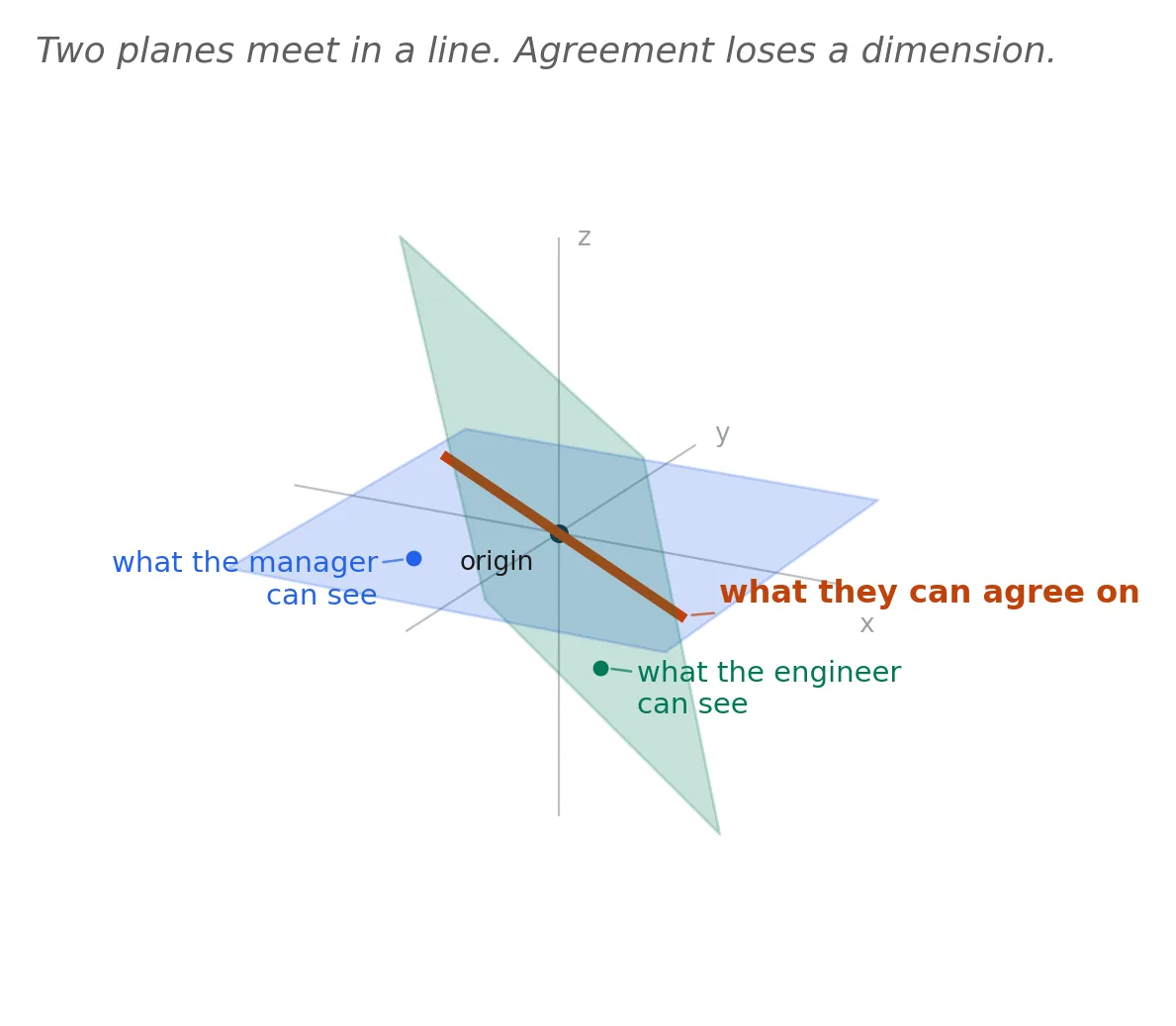
Two planes in space, each of them two-dimensional, meet in a line. Not in a richer surface — in a line, which has one dimension, fewer than either observer walked in with. That's not a quirk of the drawing; it's what happens generically when you intersect subspaces, and it goes the same way with four observers as with two. A fifth interviewer cannot make the shared space larger. They can only hold it where it is, or shrink it.
So the four interviewers do not produce a four-times-richer picture of Ari. And what they agree on is not reliably something any of them saw: each report was extrapolated before it reached the room, so four people can converge on a direction none of them observed. They produce something thinner than any one of them had alone — and the process that produces it is called building consensus, and it feels, from inside the room, like converging on the truth.
The one interviewer who saw something nobody else saw was carrying the only new information in the building. And the meeting is designed to discard exactly that: a reading nobody can corroborate is, by the room's own standards, the definition of a weak signal.
The faculty that can file a report
Iain McGilchrist describes two ways of attending to the world that we need both of.2 One takes a thing out of its context, holds it still, breaks it into parts, and re-presents it — presents it again — as a model it can manipulate. The other attends to the whole, in context, alive, and to what's between things rather than only to the things. The first he calls the emissary; the second, the master. The emissary is enormously capable and was never meant to be in charge.
The dimensional reading of that is mine, not his — he's writing about kinds of attention, not about rank, and I'd rather say so than let a borrowed frame carry more weight than it was built for. But the mapping is hard to unsee. To re-present something is to render it in some fixed set of categories, because that's what representation is; there's no such thing as representing a thing in all the ways it could be taken. Whatever can hand you a model has already chosen a basis. And the faculty that attends to the whole person doesn't have that limitation, and also cannot hand you anything — you can't put it in a debrief, a rubric, or a performance review, because the moment you write it down it's been re-presented, in coordinates, by the other one.
Which is the bind, stated plainly. The part of you that met Ari can't file a report. The part of you that files the report never met them.
What to do on Friday
None of this recovers a deleted direction. I don't have a method for seeing what you have no axis for, and I'd distrust anyone selling one. What's available is narrower, and it's still worth having.
Stop converging. The output of a debrief should be the union of what four people observed, kept in their own words, and not a number that four people can live with. When an interviewer says something the others can't corroborate, that's the sentence to write down verbatim rather than the one to discount. Treat an uncorroborated observation as expensive information, because it is: it's the only kind the room can't manufacture.
Vary the room, on purpose. If a second reading matters, it has to come from a setting that excites different directions — a working session instead of a fourth conversation, a problem with a person in it and not only a system. Same room, same projection, and the agreement you get back is an artifact of the furniture.
Ask who taught you the axis. This is the closest thing there is to reading your own operator, and it takes about ten seconds. Before you commit to a judgment about somebody, name the earlier person it came from. Sometimes there isn't one and the reading stands. Often there is, and they're standing in the room wearing the candidate's face.
Say what the hour couldn't reach. A write-up that ends with the two or three things this particular conversation had no way to test is more honest than a score, and it's the only artifact in the process that points at the missing directions instead of quietly papering over them.
None of that will get you the person. It will stop you believing the picture is the person.
Ari got an offer, eventually, after a fifth conversation that somebody scheduled because the room couldn't agree. It went well. Everyone said afterward that the debrief had worked.
Four people met Ari that Thursday, and four different people walked out of those rooms. The fifth — careful and warm and curious and fine, the one they finally agreed on, the one the offer was written for — is the only one who was never in the building.
Footnotes
-
Ari is invented, and so are the four interviewers and the debrief. They're a composite of hiring loops I've sat in rather than a report of one, and no real candidate or colleague is described here. Nothing in the argument rests on the details of the case; they're there to keep the abstraction honest. The image at the top is generated rather than photographed, and shows the same invented people: no real person appears in it. ↩
-
Iain McGilchrist, The Master and His Emissary: The Divided Brain and the Making of the Western World (Yale University Press, 2009). The two modes, the master-and-emissary relation, and the emissary's overreach are his; the dimensional reading of them is mine, as the text above says. ↩

Eric Garcia, PhD
Founder & Principal Consultant
PhD in Machine Learning from UW. Former Spotify ML engineer. 15+ years building production ML systems.
Learn more about Eric →Need Help with Production ML?
We help companies build ML systems that actually work.
Learn About Our ML Consulting